
Summa Philosophica
Cosmos & Consciousness: A Philosophy of Being, Time & Eternity

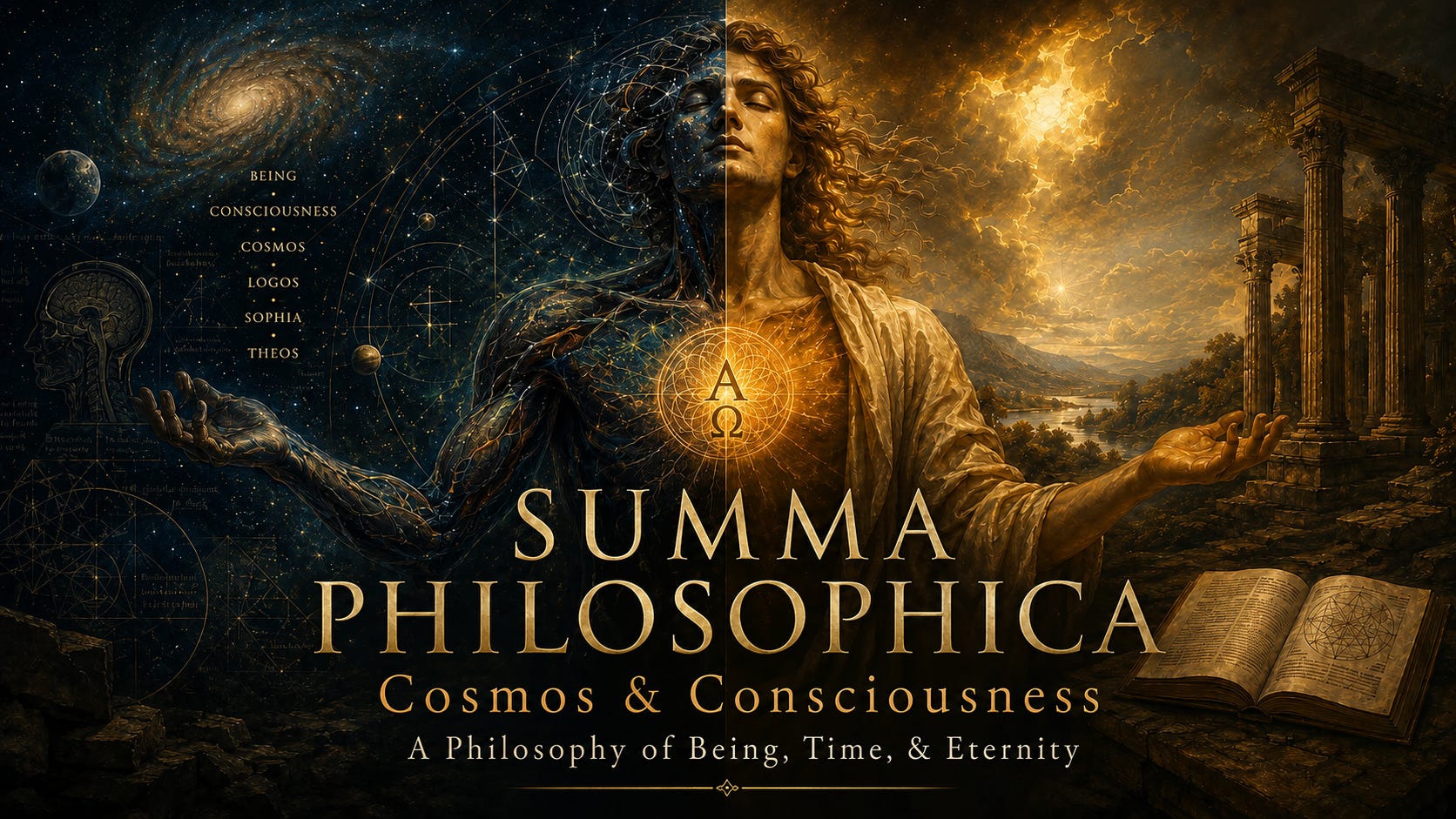
PROLOGUE — THE WORLD APPEARS
I. Let There Be Light
Not first the atom, not first the void, not first the blind collision of orphaned particles in a homeless dark, not first the idiot lottery of matter amusing itself by eventually pretending to be mind. Not first the laboratory, that chapel of polished instruments where the modern priest, having banished the gods, kneels before calibrated glass and congratulates himself on his atheism while begging Reality to become measurable. Not first the theorem, not first the empire, not first the appetite, not first the animal grunt dressed later in grammar and crowned with a doctoral hood. First: light.
But light is already too small a word, because men have imprisoned it in lamps, stars, equations, retinas, wavelengths, electromagnetic notations, and the narrow vanity of useful things. They have made light into something that allows them to see other things, as though the first miracle were a servant carrying a candle into the pantry of objects. They have forgotten that light is not merely what illuminates the world. Light in the sense of illumination is the event by which world becomes possible.
Before anything can be counted, anything must appear. Before anything can be weighed, it must be given. Before the mind can doubt, before the hand can touch, before desire can reach, before science can dissect, before philosophy can define, before theology can praise, before grief can kneel beside the bed of the beloved and discover that no doctrine has yet abolished tears, there is this astonishing, impossible, immediate fact: something is manifest.
The world appears.
This is not a conclusion. It is older than conclusion. It is not an inference. It is the condition under which inference is even possible. It is not a hypothesis waiting in the lobby of verification, hat in hand, hoping the committees of authorized cleverness will allow it to enter. It is the primordial splendor before which every hypothesis, every system, every empire of explanation, every microscope, every scripture, every song, every scream, every cradle, and every tomb stands already indebted.
The world appears, and in appearing it does not arrive as neutral furniture in a warehouse of space. It arrives as depth. It arrives as color, pressure, ache, distance, nearness, fragrance, terror, proportion, invitation, wound, music, resistance, body, sky, hunger, mother, stone, flame, river, face. It arrives not as dead fact but as disclosed presence. To be is not first to be stored somewhere in the inventory of matter. To be is to stand forth in the radiance of manifestation.
This is the first philosophical act: not to explain the world, but to receive the fact that there is world at all.
And immediately the little clerk in the skull, that efficient bureaucrat of reduction, begins stamping papers. Light? Photons. Color? Wavelength. Love? Neurochemistry. Beauty? Sexual selection. Thought? Computation. Conscience? Social conditioning. Soul? Myth. God? Projection. Eternity? Primitive anxiety before death. Give him a rose and he will reduce it to reproductive strategy. Give him a cathedral and he will explain load-bearing stone. Give him Bach and he will murmur ratios. Give him a martyr and he will diagnose pathology. Give him Paradise and he will ask for geological coordinates.
This clerk is useful in his office and catastrophic on the throne.
For the question is not whether photons travel, whether nerves fire, whether bodies evolved, whether stars condense, whether brains mediate experience, whether matter obeys lawful pattern. Of course they do. Let the physicist have his equations, the biologist her organisms, the chemist his bonds, the mathematician her radiant abstractions, the engineer his bridges, the physician his difficult mercy. Let every honest science stand honored in its proper temple. The crime begins only when a branch declares itself the root, when the lamp declares itself the sun, when the map declares itself the continent, when measurement declares that only the measurable is real.
Light is not less than physics. It is more.
The first light is the opening of Appearance. It is the primal unveiling by which Cosmos, Consciousness, and Spirit arise together in one indivisible act of manifestation. Cosmos is the Content that appears: form, order, world, matter, law, body, star, tree, number, temple, wound. Consciousness is the Field in which appearing is apprehended: inwardness, awareness, experience, value, memory, judgment, wonder. Spirit is the Dynamism by which appearance moves through Time: breath, tension, desire, history, fall, return, transformation, and transfiguration.
Do not separate them too quickly. The knife of abstraction is sharp, and necessary, but it has murdered many living things in the name of clarity. Cosmos without Consciousness becomes dead mechanism. Consciousness without Cosmos becomes vaporous dream. Spirit without both becomes sentiment, frenzy, or ghost. But in the first light they are not three corpses awaiting philosophical autopsy. They are one living triune disclosure: world appearing, world apprehended, world moving.
Let there be light means: let there be manifestation.
Yet even manifestation is not complete.
Here the Work begins against every idol of totality. The world appears, yes; but the appearing world is not the whole of Reality. It is real, but not self-grounding. It is intelligible, but not self-exhausting. It is beautiful, but not self-sufficient. It is lawful, but not ultimate. It is given, but not the Giver. It is revelation, but not the full blaze of SOURCE.
Every finite thing is a confession. The stone confesses weight but not why there is being. The flower confesses form but not the inexhaustible Beauty that wounds us through its passing. The face confesses presence but not the infinite depth of personhood. The corpse confesses mortality but not the final meaning of the soul. The star confesses fire but not the Source of light. The universe confesses order but not the ground of order. The world confesses Reality by failing to contain Reality.
This failure is not a blemish. It is the signature of manifestation.
The finite reveals the infinite by being unable to imprison it. The temporal reveals Eternity by being unable to exhaust it. The visible reveals Mystery by opening toward the invisible. The known reveals the unknown not as negation, but as depth. A world that could be completely explained would not be a world. It would be a dead diagram inside the skull of a minor demon.
Therefore the first doctrine of this Work is not possession, but incompleteness.
The revealed experiential world is ontologically incomplete. It does not mean unreal. It does not mean false. It does not mean merely subjective, merely material, merely symbolic, merely psychological, merely theological, merely anything. “Merely” is the favorite adverb of mental starvation. The world is not merely. The world is magnificently, terrifyingly, sacramentally real. But it is real as disclosure, and disclosure implies depth beyond what is disclosed.
Appearance is revelation. Revelation is not exhaustion. Therefore Mystery remains.
And Mystery is not the fog into which lazy thought retreats. Mystery is not the decorative incense burned by defeated reason. Mystery is not ignorance wearing a purple robe. Mystery is the inexhaustibility of SOURCE. Mystery is what remains not because we have failed to think, but because thinking, when it becomes honest, discovers that Reality exceeds enclosure. The child asks why there is something rather than nothing; the professor pretends the question is naïve because he cannot answer it without leaving his jurisdiction. The child is nearer wisdom.
Let there be light, then, is not the solving of darkness. It is the birth of the visible from the inexhaustible invisible. But here, already, one must speak with fear, because the first light carries within it the possibility of the Fall. This is the meaning of: the Fear of the Lord is the beginning of Wisdom,
Paradise is not a garden located by cartographers between two rivers and lost to agricultural mismanagement. Paradise is participation in Eternity. It is the soul’s unbroken dwelling in SOURCE, where being is not yet exile, where knowledge is not yet fragmentation, where desire is not yet hunger, where difference is not yet alienation, where the creature receives itself from God without grasping itself against God. Paradise is not childish innocence but eternal immediacy: the creature standing in the light without trying to steal the light.
The Fall is the fall from Eternity into Time.
Time begins with the Fall.
This must be understood or everything becomes sentimental nursery religion on one side and mechanical barbarism on the other. Time is not merely a neutral container in which morally interesting incidents occur. Time is the wound of separation, the distance between origin and return, the measure of exile, the interval in which the soul must remember what it has lost and become capable of receiving what it cannot seize. Time is the road away from Paradise and the spiral back toward SOURCE.
Before the Fall, not before in chronological sequence, for chronology itself belongs to the fallen condition, but before as ontological priority, there is eternal participation. After the Fall, there is succession. There is before and after, hunger and labor, memory and anticipation, birth and death, seedtime and harvest, empire and ruin, cradle and grave, promise and delay. The soul no longer rests in Eternity; it moves through Time. And because it moves through Time, it suffers history.
History is the biography of fallen consciousness seeking return.
Yet Time is not evil. This is where hatred of creation begins its old poisonous sermon, and this Work will not kneel before it. Time is wounded, but not worthless. Time is exile, but also pilgrimage. Time is the field of death, but also the field of repentance, art, courage, love, incarnation, and restoration. The Fall opens the drama in which Spirit moves. What was immediate in Paradise must become conscious through history. What was given in Eternity must be freely returned through love.
Thus Time is the dynamism of Spirit under the condition of exile.
It spirals because the soul cannot return by reversing a clock. There is no childish restoration by mere backward movement. Eden cannot be recovered by nostalgia, archaeology, nationalism, primitivism, revolution, or scented candles in the boutiques of spiritual exhaustion. The way back is not back. The way back is through. Through knowledge, through suffering, through freedom, through the wilderness, through the city, through law, through prophecy, through empire, through collapse, through conscience, through the cross, through death, through the harrowing of hell, through the fire in which every idol screams as it burns.
Reality is structured as a Golden Spiral because return is not repetition. It is recapitulation transformed by depth. What falls from Eternity into Time does not simply climb a ladder back to the same innocence. It moves through history toward transfigured communion. The spiral preserves origin, loss, memory, development, catastrophe, judgment, and restoration. It is the geometry of exile and return.
This is why civilizations rise and fall.
A civilization is a collective soul wearing stone, law, ritual, market, army, theater, calendar, and crown. It is born when a people receives a symbol strong enough to organize its terror. It grows when myth becomes institution, courage becomes law, sacrifice becomes architecture, and memory becomes education. It flowers when form and energy hold one another in difficult proportion. It decays when success fattens the body and hollows the spirit. It falls when cleverness replaces wisdom, luxury replaces discipline, calculation replaces reverence, and the children of the builders inherit marble halls in which they can no longer hear the voice of God.
Then comes the barbarism of reflection: men so rational they can no longer think, so educated they can no longer know, so liberated they can no longer love, so ironic they can no longer kneel, so stimulated they can no longer feel, so individual they can no longer belong, so humane in theory that they sacrifice actual persons to abstractions with exquisite manners.
This, too, is light fallen into Time.
The first light becomes the light of stars, then torches, then altars, then libraries, then laboratories, then screens, then the cold blue glare on faces no longer able to look at one another. Every age receives light and is judged by what it does with it. The Age of Gods kneels before it. The Age of Heroes fights beneath it. The Age of Men analyzes it. The Age of Reflection sells it, mocks it, digitizes it, weaponizes it, and finally wonders why the dark has returned.
But the dark never finally conquers light, because darkness is not a substance equal to light. Darkness is privation, refusal, concealment, exile, shadow cast by blocked radiance. Evil is real, terribly real, concretely real in war, rape, torture, famine, slavery, murder, cruelty, humiliation, abandoned children, butchered bodies, bureaucratic death, and the polished smile of power. But evil is not SOURCE. Evil cannot create being. It can only vandalize manifestation.
Light remains deeper than ruin.
This does not absolve history. It condemns it. The light by which the world appears is also the light by which the world is judged. Nothing is hidden forever. Every empire will be read aloud. Every market will be weighed. Every laboratory will answer for what it served. Every state will stand naked without flags. Every ideology will be stripped of its hymns. Every civilization will discover whether its temples were built for God, gold, blood, machine, appetite, or itself.
The light reveals; therefore the light judges.
And yet judgment itself is not the final word, unless God is smaller than justice and Eternity is less than mercy. Judgment unveils reality against lies so that restoration can become possible. The soul cannot be healed while it clings to falsehood. Civilizations cannot be renewed while they worship their own decay as sophistication. The world cannot return while it mistakes exile for home.
Let there be light is therefore also: let there be truth.
Truth is not the private property of specialists. It is not manufactured by consensus, markets, states, algorithms, universities, priests, parties, or mobs. Truth is the conformity of apprehension to Being, and Being is luminous because Reality gives itself. Falsehood is always parasitic upon some stolen light. The liar must borrow the grammar of truth in order to deny it. The materialist must use consciousness to declare consciousness secondary. The relativist must make an absolute claim in order to abolish absolutes. The nihilist must treat meaninglessness as meaningful enough to announce. The idolater must carve his god from the wood of the real.
The first light exposes these little thefts.
Yet philosophy must beware of its own theft. The philosopher too may become an idolater of concepts. He may trap living Reality in a system and call the cage a cathedral. He may become intoxicated by coherence until he forgets that coherence is not SOURCE. He may build a magnificent map of the ocean and drown because he mistook water for parchment. This Work must therefore become a system against false system, an architecture open to sky, a cathedral whose roof breaks into stars.
A true philosophy must be comprehensive enough to embrace Cosmos, Consciousness, Spirit, Time, history, civilization, science, art, myth, ethics, politics, the soul, death, evil, beauty, and God; but humble enough to confess that SOURCE remains inexhaustible. Anything less is either cowardice or idolatry.
The world appears.
The appearing world is lighted from beyond itself. It does not produce its own appearing by rearranging its furniture. Matter does not wake itself into experience by becoming complicated enough to hallucinate value. Mechanism does not secrete meaning the way a gland secretes fluid. Quantity does not accidentally blossom into the anguish of Hamlet, the tenderness of a mother, the rose window of Chartres, the terrible mercy of Lear, the cry of the crucified, the mathematics of the stars, the guilt of the murderer, the laughter of a child, or the beauty of a face remembered forty years after it vanished into earth.
No. The world appears because Being is given.
And Being is given because SOURCE gives.
But SOURCE, in giving, is not exhausted by the gift. The sun is not diminished by the morning. The fountain is not emptied by the river. The singer is not contained by the song. The mother is not exhausted by the child. The author is not imprisoned in the book. The Infinite is not consumed by the finite world.
Therefore the world is real, and more than the world is real.
Let there be light: let the finite show the infinite without claiming to be the infinite. Let Cosmos shine as Content. Let Consciousness awaken as Field. Let Spirit move as Time. Let Time begin in the Fall and spiral toward restoration. Let history rise in civilizations and bury them when they forget the Source of their fire. Let science measure what can be measured and kneel before what cannot. Let philosophy think until thought becomes reverence. Let poetry speak where prose limps. Let myth remember what ideology flattens. Let theology praise what it cannot possess. Let the soul stand inside the wound of manifestation and call the wound a door.
For light is not merely brightness. Light is disclosure.
And disclosure is the first mercy.
Even the Fall, terrible as it is, occurs in light. Even exile is visible. Even death is known. Even suffering cries out. Even sin is exposed. Even the lost soul remembers enough of Paradise to know that it is lost. This is why despair is never metaphysically final. The one who says there is no light speaks by a light he has not made. The one who says there is no truth depends upon the truth of his denial. The one who says there is no God stands in a world whose every atom burns with borrowed existence.
The first fact remains.
The world appears.
And because it appears, Being is not hidden absolutely. Because it is incomplete, Being is not exhausted by appearance. Because Time begins with the Fall, history is the drama of return. Because Time spirals, no collapse is the final circumference. Because SOURCE gives, Eternity remains. Because Eternity remains, Mystery is inexhaustible.
Let there be light.
And there is light: not solved, not possessed, not domesticated, not reduced, not safely filed beneath matter, mind, myth, politics, psychology, or primitive thunder; but living light, terrible light, tender light, judging light, creating light, light before the sun, light inside the soul, light beneath the ruin, light above the empire, light in the tomb, light at the root of thought, light as the first opening of Reality into manifestation.
The Work begins here.
Not with an answer.
With radiance.
II. The Given Is Not Enough
The world appears.
But the world that appears does not explain why it appears. It gives itself, lavishly, immediately, with the scandalous generosity of light, body, color, sound, pressure, distance, memory, wound, and face; yet in the very act of giving itself, it exposes a poverty no inventory can repair. The world is given, but the given is not enough.
This is not contempt for the world. Contempt for the world is usually the secret revenge of the disappointed idolater, the spiritual tantrum of a soul that demanded infinity from finite things and, not receiving it, turned against creation itself. The world is not to be despised. The world is to be received. It is true, beautiful, terrible, lawful, intimate, resistant, luminous, and real. The stone is real. The tree is real. The body is real. The kiss is real. The grave is real. The sky is real. Bread is real, blood is real, music is real, mathematics is real, suffering is real, and the face of the beloved is more real than the sterile abstractions with which frightened men defend themselves against love.
But none of these is enough.
The given is not enough because the given cannot ground its own givenness. The world appears, but does not disclose within itself the final reason that there is appearance rather than absolute non-disclosure. The universe may stretch through unimaginable distances, flare with galaxies, curve under gravity, blossom with worlds, and grind its stars into dust; still no accumulation of objects explains why there are objects. A trillion suns do not explain light. They exhibit it. A billion minds do not explain Consciousness. They participate in it. An endless chain of causes does not explain causality. It presupposes the order it tries to extend.
The given is not enough because explanation within the world is not the same as explanation of the world.
This distinction, small to the hurried intellect, is a gate of fire. Once crossed, whole empires of fashionable stupidity fall behind us like painted scenery. Science explains relations among given things. It explains motion, composition, inheritance, pressure, radiation, structure, reaction, development, decay. It is magnificent when it remains loyal to its calling. But science begins after the world is already given, after intelligibility is already operative, after Consciousness is already awake, after number already binds, after order already holds, after truth is already worth seeking. Science does not create these conditions. It inherits them.
The microscope does not explain visibility.
The telescope does not explain manifestation.
The equation does not explain intelligibility.
The brain scan does not explain the appearing of experience.
The laboratory does not explain Being.
To say this is not to diminish science. It is to rescue science from the swollen metaphysical incompetence of scientism, that thin little Caesar in a lab coat, forever mistaking his jurisdiction for the whole empire of Reality. Science is glorious within the given. It becomes ridiculous when it declares that the given has no depth beyond its methods. A man with a ruler may measure the nave of Chartres, but if he then declares the cathedral exhausted because he has numbered its stones, he has not become scientific. He has become blind with instruments in his hands.
The given is not enough because every given thing points beyond itself.
A flower is not merely a flower. It is seed, soil, rain, sun, season, geometry, fragility, color, scent, insect, hunger, death, renewal, and gift. It is itself, but it is not merely itself. A face is not merely skin over bone. It is history, memory, sorrow, secrecy, childhood, desire, ancestry, hope, fear, promise, and the abyssal inwardness of personhood. A word is not merely sound. It is intention, meaning, inheritance, distinction, invocation, wound, blessing, lie, prayer, command. A civilization is not merely population under administration. It is myth, law, discipline, hunger, symbol, architecture, sacrifice, erotic order, economic exchange, metaphysical terror, and collective memory struggling against the dark.
Nothing real is merely itself because reality is relational, symbolic, participatory, and deep.
The modern reductionist thinks he has explained a thing when he has lowered it to its conditions. He explains poetry by language, language by neurology, neurology by chemistry, chemistry by physics, physics by mathematics, and mathematics by a shrug, which he then mistakes for intellectual courage. His method is simple: take the living whole, strangle it into components, identify the components as prior, then announce that the whole was never anything but the parts from which his own abstraction has just butchered it.
This is not explanation. It is metaphysical taxidermy.
The given is not enough because the whole is not a decorative name pasted upon parts. The whole is the order by which the parts become what they are. A melody is not a pile of notes. A body is not a crowd of organs. A poem is not a sack of words. A marriage is not a legal arrangement between biological appetites. A person is not a temporary dictatorship of cells. A world is not a heap of particles that, through sufficient confusion, began writing metaphysics.
The parts exist within form. Form exists within intelligibility. Intelligibility exists within disclosure. Disclosure exists within Consciousness. Consciousness opens toward SOURCE. Therefore the given, precisely because it is given as order, meaning, and presence, cannot be complete in itself.
The given is not enough because it dies.
Here every easy philosophy is dragged by the hair into the cemetery.
The world gives beauty, and then beauty fades. It gives childhood, and childhood vanishes before the child understands what has been given. It gives love, and love is threatened from the first by time, betrayal, weakness, sickness, and death. It gives the body, and the body is already under sentence. It gives civilizations, and every civilization carries its ruin as the seed carries the tree. It gives empires, and the empire that engraves eternity upon its marble eventually becomes a tourist photograph, a disputed excavation, or a proverb about arrogance. It gives genius, and genius becomes dust. It gives the saint, the mother, the soldier, the builder, the poet, the philosopher, the tyrant, the merchant, the child, and then one by one the earth closes its brown mouth over them all.
If the given were enough, death would be merely natural. It is natural, but it is not merely natural. Death belongs to the given world, yet every human being knows, however dimly, that something is violated in death. The corpse is not an argument. It is an accusation. It accuses every system that calls extinction sufficient. It accuses every optimism that calls decay progress. It accuses every materialism that tells the grieving mother her child has merely ceased functioning. It accuses every religion that speaks too quickly. It accuses philosophy itself, unless philosophy has the courage to stand beside the grave and think without lying.
Death reveals that the given is real, but not complete.
The flower’s fading does not make the flower unreal. The beloved’s death does not make the beloved an illusion. The ruin of a civilization does not mean civilization was meaningless. But the perishability of the given prevents the given from becoming ultimate. Whatever passes cannot be SOURCE. Whatever dies cannot be the final ground of life. Whatever is received cannot be the Giver. Whatever appears cannot be the whole of that by which appearance is possible.
The given is not enough because desire exceeds it.
Man is the creature who wants more than survival. He wants bread, yes, but also meaning. He wants shelter, but also beauty. He wants reproduction, but also love. He wants society, but also justice. He wants knowledge, but also wisdom. He wants pleasure, but also blessing. He wants life, but not merely continuance. He wants eternity, though he may disguise the longing in power, sex, wealth, revolution, empire, fame, art, philosophy, theology, technology, or the endless little narcotics by which modern despair keeps itself entertained.
Desire is evidence.
Not proof in the vulgar courtroom sense, where metaphysical realities must stand trial before men who believe only in what their instruments can register, as though their instruments could register the assumptions that make instrumentation meaningful. Desire is evidence as hunger is evidence of food, thirst of water, homesickness of home, grief of love, longing of an absent fulfillment. Not every desire is pure. Not every longing is rightly aimed. The soul is a magnificent archer with a broken hand. But the misdirection of desire does not abolish its metaphysical testimony.
The finite creature longs beyond the finite.
This longing is the wound of Eternity in Time. It is the memory of Paradise after the Fall. Not memory as recollection of a dated event, not nostalgia for a vanished garden somewhere behind Mesopotamian clouds, but ontological memory: the soul’s ache because it belongs more deeply to Eternity than to the succession in which it now suffers. Time begins with the Fall because Time is the distance between participation and return. Desire is the soul’s experience of that distance.
The given is not enough because we remember what we have never possessed in Time.
This is why beauty wounds. If beauty were merely pleasant arrangement, we would enjoy it and move on. But true beauty stops us, opens us, pierces us, and leaves behind not satisfaction but intensified longing. A sunset does not merely please the eye; it accuses the heart of exile. Music does not merely entertain the ear; it awakens a country no map contains. The face of the beloved does not merely satisfy appetite; it reveals the unbearable depth of personhood, and therefore the impossibility of possessing another as object. The beautiful says: this is real, and yet this is not all.
Beauty is the splendor of the given confessing its own incompleteness.
The given is not enough because moral value exceeds utility.
No serious soul believes, in the hour of trial, that good and evil are merely preferences, social conveniences, evolutionary strategies, or local arrangements of nervous tissue. Men may say so at dinner parties, universities, conferences, and in books written with the cold confidence of the spiritually underfed; but when betrayed, tortured, humiliated, enslaved, abandoned, or forced to watch the innocent crushed beneath power, they do not complain that their preferences have been inconvenienced. They cry injustice.
Justice is not utility wearing ceremonial clothes. Mercy is not reproductive advantage. Courage is not chemical weather. Evil is not inefficient organization. The person is not sacred because society has voted him temporarily useful. The child is not inviolable because the tribe gains long-term adaptive benefit from restraint. The martyr does not become meaningful because his nervous system malfunctioned nobly. Moral reality stands forth in experience with an authority no sociology can manufacture.
The good is given, but its authority exceeds the given order of appetite, power, and survival.
This is why every civilization is judged by what it worships. If it worships SOURCE, even imperfectly, it remembers that the person exceeds the state, the market, the machine, the tribe, and the pleasure of the strong. If it worships itself, it begins counting bodies. The city that forgets transcendence does not become rational. It becomes efficient at desecration. It learns to call sacrifice policy, lust freedom, cowardice nuance, propaganda education, surveillance safety, murder necessity, and spiritual emptiness sophistication.
The given is not enough, and when a civilization denies this, it feeds human beings to finite gods.
The market idol says man is appetite and price. The state idol says man is material for order. The class idol says man is function inside struggle. The nation idol says man is blood and flag. The race idol says man is biology enthroned. The technology idol says man is obsolete flesh awaiting optimization. The progress idol says man may be sacrificed today for tomorrow’s shining abstraction. The pleasure idol says man should dissolve into sensation. Each idol takes something real from the given world and inflates it into ultimacy. This is the essence of idolatry: the partial dressed as absolute.
The given becomes demonic when treated as ultimate.
The body is good; worshiped, it becomes lust, vanity, terror of age, and hatred of limits. The mind is good; worshiped, it becomes pride, abstraction, and icy contempt. The state is necessary; worshiped, it becomes Leviathan. The market is useful; worshiped, it becomes Moloch with better accounting. Science is noble; worshiped, it becomes a priesthood of sanctioned blindness. Technology is powerful; worshiped, it becomes an altar on which the human is gradually disassembled. Nature is sacred; worshiped without transcendence, it becomes the chthonic abyss demanding submission to force.
Only SOURCE can be ultimate without becoming an idol, because SOURCE alone is not a finite thing inflated beyond its truth.
The given is not enough because civilization itself proves the insufficiency of the given.
Every great civilization begins by reaching beyond survival. It raises stones toward the heavens, buries its dead with ceremony, tells myths of origin, paints animals in caves with an exactness that exceeds hunger, tracks the stars, orders marriage, sanctifies law, crowns kings, builds temples, sings laments, punishes murder, honors courage, remembers ancestors, fears judgment, and seeks blessing. No civilization is born from mere consumption. Consumption may sustain bodies; it cannot found worlds.
A civilization rises when a people gathers around a sacred center. It falls when the center hollows out.
Then the given, severed from SOURCE, becomes heavy. Wealth becomes luxury. Luxury becomes softness. Softness becomes resentment against discipline. Reason becomes cleverness. Cleverness becomes irony. Irony becomes corrosion. Freedom becomes appetite. Appetite becomes addiction. Equality becomes leveling. Tolerance becomes cowardice. Compassion becomes performance. Law becomes procedure. Education becomes credentialing. Art becomes provocation. Religion becomes therapy. Politics becomes management of decline. And at last the civilization becomes so reflective that it can explain everything except why it no longer wants to live.
This is Vico’s barbarism of reflection, though the disease is older than the name. It is the terminal cleverness of societies that have analyzed their own souls into powder. They do not return to primitive strength; they descend into sophisticated savagery. They still have libraries, courts, universities, screens, agencies, markets, data, experts, and humane vocabulary. But beneath the polished diction, the wolf has returned wearing a conference badge.
The given is not enough, and a civilization that forgets this begins to die.
Spengler saw cultures harden into civilizations, spring into winter, symbol into system, soul into mechanism, destiny into administration. Ibn Khaldun saw asabiyyah, the fierce cohesion of founding peoples, dissolve under luxury and softness. Polybius saw regimes rotate through their corruptions, each form carrying its shadow. Hesiod heard the iron age groaning under toil and moral exhaustion. Plato watched the soul’s disorder become the city’s disorder. Aristotle knew regimes decay when their form loses proportion. Paglia saw Apollo’s fragile order forever threatened by Dionysian and chthonic return.
They saw truly, but not completely.
For history is not merely circular. If it were merely circular, wisdom would become despair with better memory. Civilizations rise and fall, but their cycles occur within the Golden Spiral of SOURCE. Collapse is real, but not final. Ruin is real, but not meaningless. The fall of one symbolic world becomes the buried seed of another. The sins of empires become instruction written in blood. The ashes of temples become soil for new altars. The martyr’s grave becomes architecture. The songs of the conquered outlive the monuments of conquerors. History repeats, but never merely repeats. It returns with difference, judgment, memory, and hidden ascent.
The given is not enough because Time itself is not enough.
Time devours everything it gives. This is its terror. Yet Time also gives room for repentance, growth, creation, forgiveness, discipline, pilgrimage, and love. This is its mercy. Time begins with the Fall, but the Fall does not make Time meaningless. Time is exile, but exile can become journey. Time is the wound, but the wound can become door. Time is the distance from Paradise, but also the road of return. What was lost in eternal immediacy must be freely regained through history, or rather received again beyond possession, beyond grasping, beyond the theft at the root of the Fall.
Time is not ultimate because Time is not SOURCE.
Time points beyond itself by its very structure. The present vanishes as soon as it appears. The past is no longer, and yet it is not nothing, for it binds memory, guilt, promise, inheritance, identity. The future is not yet, and yet it acts upon us through hope, fear, expectation, vocation, and destiny. The present, if isolated, cannot be held; it is a knife-edge of appearance. Thus temporal existence is a strange poverty: real, but unstable; given, but passing; meaningful, but incomplete.
The soul knows this. That is why it seeks Eternity.
But Eternity is not endless extension of Time. Endless Time would be nightmare, not salvation: infinite succession without fulfillment, an immortal prison of before and after. Eternity is not more time. Eternity is the Source of Time, the depth in which all temporal becoming has its ground, meaning, and possible transfiguration. To fall from Paradise is to fall from participation in Eternity into the drama of Time. To return is not to abolish the world, but to have Time transfigured in Eternity.
The given is not enough because it is given from beyond itself and returns beyond itself.
This is the structure of all manifestation. SOURCE gives. Cosmos appears. Consciousness apprehends. Spirit moves. Time spirals. History unfolds. Civilizations rise and fall. Souls awaken, forget, suffer, remember, and seek return. Beauty wounds. Death accuses. Love exceeds possession. Justice exceeds utility. Thought exceeds mechanism. Being exceeds concept. Revelation exceeds doctrine. Mystery exceeds system.
Every road, followed honestly, opens beyond the given.
The tragedy of modern thought is not that it knows too much. It knows too little and congratulates itself too loudly. It has mistaken method for metaphysics, data for wisdom, information for illumination, power for truth, stimulation for joy, skepticism for depth, and disenchantment for maturity. It has taken the given world, stripped it of SOURCE, declared the remainder sufficient, and then wondered why the soul starves in the banquet hall.
The world without SOURCE becomes a feast painted on a wall.
One may still eat, work, mate, trade, vote, consume, analyze, medicate, travel, post, optimize, and die. The machinery continues. Indeed, it often accelerates as meaning diminishes, because speed is the narcotic of the purposeless. But beneath the motion there grows a silence no entertainment can cover. The soul begins to suspect that it has inherited a kingdom and been told it lives in a warehouse. It looks at the stars and is given chemistry. It looks at death and is given procedure. It looks at love and is given hormones. It looks at evil and is given context. It looks at beauty and is given preference. It looks at consciousness and is given diagrams. It looks at God and is given sociology.
Then, if not entirely ruined, it rebels.
Philosophy begins in that rebellion against insufficiency. Not a childish rebellion against limits, but a noble rebellion against false finality. The philosopher is the one who refuses to let the finite pretend to be absolute. He refuses to let the measurable abolish the real. He refuses to let the useful devour the meaningful. He refuses to let death interpret life. He refuses to let civilization’s official idols determine the boundaries of thought. He refuses to let the given world be either despised as illusion or worshiped as complete.
He receives the world as revelation.
And because he receives it as revelation, he knows that revelation implies SOURCE.
The given is enough to begin. It is not enough to end.
This distinction governs the whole Work. We begin with the given because all honest thought begins where Reality has already opened itself. We do not begin by inventing worlds, doubting the obvious into academic mist, or pretending that consciousness can leap outside consciousness to inspect its own conditions from nowhere. We begin here: with appearing, apprehension, world, body, value, death, beauty, history, and longing.
But beginning is not completion.
The given is the first word, not the last. It is the threshold, not the sanctuary. It is the icon, not the Infinite. It is the music heard from beyond the wall, not the full presence of the Singer. It is the river, not the fountain. It is the flame, not the eternal Fire. It is the world, and the world is glorious; but the world is not SOURCE.
Therefore the Work must proceed.
It must ask what Appearance means. It must ask why Apprehension is inseparable from Appearance. It must ask why Consciousness cannot be reduced to matter, why Cosmos cannot be reduced to mechanism, why Spirit cannot be reduced to chronology, why history cannot be reduced to progress or recurrence, why civilization cannot be reduced to economy or power, why beauty cannot be reduced to pleasure, why justice cannot be reduced to utility, why death cannot be allowed the final interpretation of life, and why Eternity, necessarily implied by Time, must remain inexhaustible Mystery.
The world appears.
The given is not enough.
Therefore philosophy begins.
Stay Tuned… More to Come Soon. And other books will be published here as well. All content exclusively available on Substack. The writing and books of K.D. Fulton.